Juliana Spahr
Literary & Ecological Scholar
Pulitzer Prize in Poetry


Readings &
Lecture Topics
- An Evening with Juliana Spahr
Biography
“To be falsely comforted by poetry in our contemporary moment does a disservice to both poet and reader. One cannot write away the desecration, the wreckage. Silence, however, is its own form of desecration, and Spahr will not be silent—nor should the reader.” —Jeff Alessandrelli
“Spahr refuses easy answers: she is just as skeptical of poetry’s revolutionary potential as she is committed to its possibility. Essential reading for anyone interested in the relationship between poetry and politics.” —Jameson Fitzpatrick
“Spahr’s scenes of pastoral enchantment invoke enduring human fantasies of ecological coexistence grounded in mutual care and protection. Yet if these scenes lay the groundwork for the banishments to come, they also speak poignantly to the psychic need for these fantasies.” —Margaret Ronda
“Self-questioning and self-devouring.” —Literary Hub
Born in Chillicothe, Ohio, Juliana Spahr is a poet and scholar interested in questions of transformation, language, and ecology. Spahr’s work crosses a variety of American landscapes, from the disappearing beaches of Hawaii to the small town of her Appalachian childhood. Her books of criticism and theory include Du Bois’s Telegram: Literary Resistance and State Containment (2018) and Everybody’s Autonomy: Connective Reading and Collective Identity (2001).
Spahr’s poems have focused on reading as a “communal, democratic, and open process.” Her books of poetry include Ars Poeticas (2025), winner of the 2026 Pulitzer Prize in Poetry; That Winter the Wolf Came (2015); Well Then There Now (2011); The Transformation (2007); This Connection of Everyone with Lungs (2005); Fuck You-Aloha-I Love You (2001); and Response (1996), which won a National Poetry Series Award.
Of her poetic labors within the genre, Spahr has noted how a significant portion of her process inevitably involves responding to tensions arising from her theoretical work. She says: “Poetry feels like the springing off of the diving board and moving into the part of the dive that feels aerodynamic and smooth. The feeling of moving through the water, and then the feeling of entering into the water as if in slow motion. And it feels like what the inner smoothness that moves plovers, monarchs, whales, garden snakes, herds of walking animals from one place to another must feel like. The feeling of being set in motion. Or suddenly noticing a clenched fist and then unclenching this fist and how this sensation of unclenching travels up the hand and into the breath. Or just spreading hands wide and putting them on the floor and then kicking up into the air and balancing there.”
She has edited several volumes of essays and poetry, including Writing from the New Coast: Technique (1993); A Poetics of Criticism (1994); American Women Poets in the 21st Century: Where Lyric Meets Language (2002), with Claudia Rankine; and Poetry and Pedagogy: the Challenge of the Contemporary (2006). Spahr has also written two loosely autofictional novels, An Army of Lovers (2013) an experimental project co-written with David Buuck about which Bhanu Kapil observed, “I am fascinated by their their attention to inequality, to questions of violence and community: something borne out by the collaboration itself;” and The Transformation (2007), which tells a barely truthful story of the years 1997-2001, a story of flora and fauna, of continents, islands, academies, connective tissue, military and linguistic operations.
Spahr founded the literary journal Chain and co-edited it from 1993 to 2003 with poet Jena Osman. She won the 2009 O.B. Hardison Jr. Poetry Prize, presented by the Folger Shakespeare Library, honoring poets “whose art and teaching demonstrate great imagination and daring.”
Spahr edited Commune Editions with Joshua Clover and Jasper Bernes. She has taught at the University of Hawaii at Manoa, and is currently on the faculty at Mills College at Northeastern University.
Videos
Publications
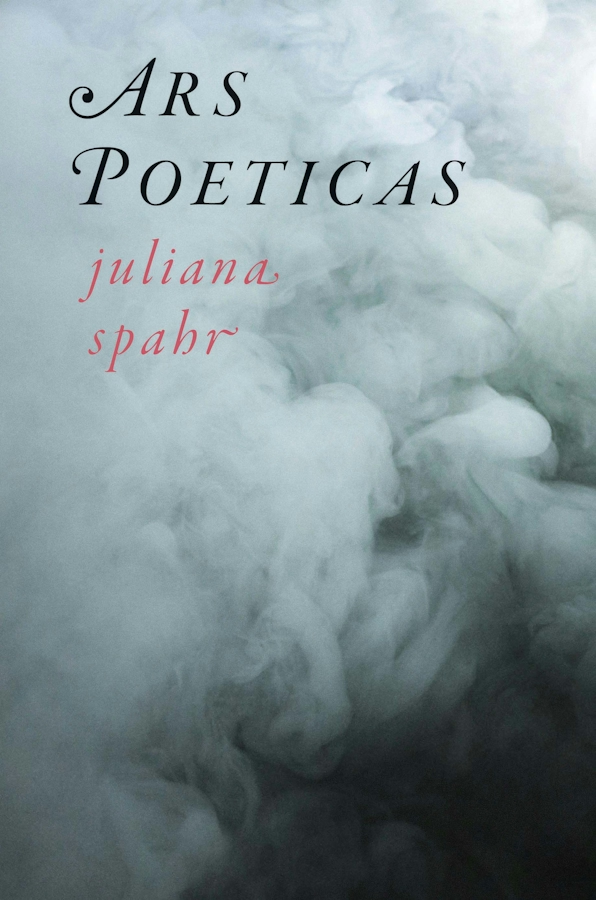
Ars Poeticas
Poetry, 2025
During the time of an increasingly powerful alt-right which was also the time when species extinction was ever increasing, Juliana Spahr sat down to read Brecht. She was looking for an answer to Brecht’s question about the dark times, about whether there will also be singing during the dark times. The answer that Brecht provides is that yes, that poets will sing of the dark times. In the six ars poeticas that Spahr writes, she sings of the dark times but also of coral, the pop song’s possible liberation, and the love of comrades. She writes not only of the rich history of what politics and poetry have done with each other, but what they might yet do together.

Du Bois’s Telegram: Literary Resistance and State Containment
Criticism, 2018
n 1956 W. E. B. Du Bois was denied a passport to attend the Présence Africaine Congress of Black Writers and Artists in Paris. So he sent the assembled a telegram. “Any Negro-American who travels abroad today must either not discuss race conditions in the United States or say the sort of thing which our State Department wishes the world to believe.” Taking seriously Du Bois’s allegation, Juliana Spahr breathes new life into age-old questions as she explores how state interests have shaped U.S. literature. What is the relationship between literature and politics? Can writing be revolutionary? Can art be autonomous, or is escape from nations and nationalisms impossible?
Du Bois’s Telegram brings together a wide range of institutional forces implicated in literary production, paying special attention to three eras of writing that sought to defy political orthodoxies by contesting linguistic conventions: avant-garde modernism of the early twentieth century; social-movement writing of the 1960s and 1970s; and, in the twenty-first century, the profusion of English-language works incorporating languages other than English. Spahr shows how these literatures attempted to assert their autonomy, only to be shut down by FBI harassment or coopted by CIA and State Department propagandists. Liberal state allies such as the Ford and Rockefeller foundations made writers complicit by funding multiculturalist works that celebrated diversity and assimilation while starving radical anti-imperial, anti-racist, anti-capitalist efforts.
Spahr does not deny the exhilarations of politically engaged art. But her study affirms a sobering reality: aesthetic resistance is easily domesticated.
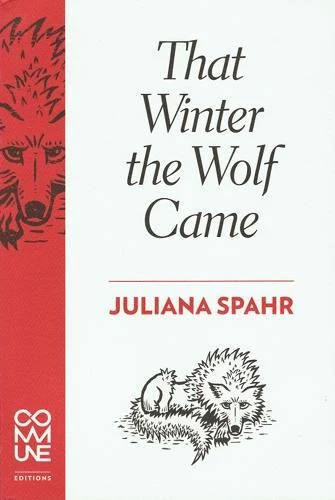
That Winter the Wolf Came
Poetry, 2015
That Winter the Wolf Came is written for this era of global struggle. It finds its ferment at the intersection of ecological and economic catastrophe. Its feminist and celebratory energy is fueled by street protests and their shattered windows. Amid oil spills and austerity measures and shore birds and a child holding its mother’s hand and hissing teargas canisters, it reminds us exactly what we must fight to defend with a wild ferocity, and what we’re up against.
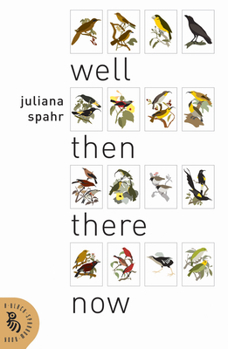
Well Then There Now
Poetry, 2011
Accretion, articulation, exploration, transformation, naming, sentiment, private and public property – these are just a few of Juliana Spahr’s interests. In this, her fourth collection of poetry, we find her performing her characteristic magic, turning these theoretical concerns into a poetic odyssey. From her first poem, written in Honolulu, Hawaii, to the last, written in Berkeley, California, about her childhood in Appalachia, Spahr takes us on a wild patchwork journey backwards and forwards in time and space, tracking change – in ecology, society, economies, herself. Through a collage of “found language,” a deep curiosity about place, and a restless intelligence, Spahr demonstrates the vibrant possibilities of an investigatory poetics. This verse is more inclusive than exclusive; Spahr writes of grape varietals, the shrinking of public beachfront in Hawaii, endangered plant, fish, and wildlife species, the melting of the polar ice caps, and comparative poverty rates. She also knows how to sing – in the oldest tradition of poetry – of loss, and her lament for nature is the most keen.
The Transformation
Non/Fiction, 2007
Juliana Spahr has lived in many places, including Chillicothe (Ohio), Buffalo (New York), Honolulu (Hawaii), and Brooklyn (New York). She has absorbed, participated in, and been transformed by the politics and ecologies of each. This book is about that process. The Transformation “tells a barely truthful story of the years 1997-2001,” a story of flora and fauna, of continents, islands, academies, connective tissue, military and linguistic operations, and of that ever-present we, to name only a few. At once exhilarating, challenging, and humbling, THE TRANSFORMATION is a hefty book in its honesty and scope, a must-read.

This Connection of Everyone with Lungs
Poetry, 2005
Part planetary love poem, part 24/7 news flash, the hypnotic poems of This Connection of Everyone with Lungs wrap with equal, angular grace around lovers and battleships. These poems hear the tracer fire in a bird’s song and capture cell division and troop deployments in the same expansive thought. They move through concentric levels of association and embrace ―from the space between the hands to the mesosphere and back again―touching everything in between. The book’s focus shifts between local and global, public and private, individual and social. Everything gets in: through all five senses, through windows, between your sheets, under your skin.

Things of Each Possible Relation Hashing Against One Another
Poetry, 2003
Australian ethnohistorian Greg Dening argues that there are two views that define the Pacific: a view from the sea (the view of those who arrived from elsewhere) and the view from the land (those who were already there). Things of Each Possible Relation Hashing Against One Another is a series of poems that opens with the view from the sea and ends with the view from the land and are about the ecological hashing that happens as these two views meet in Hawai’i.

American Women Poets in the 21st Century: Where Lyric Meets Language
Anthology, 2001
Poetry in America is flourishing in this new millennium and asking serious questions of itself: Is writing marked by gender and if so, how? What does it mean to be experimental? How can lyric forms be authentic? This volume builds on the energetic tensions inherent in these questions, focusing on ten major American women poets whose collective work shows an incredible range of poetic practice.
Each section of the book is devoted to a single poet and contains new poems; a brief “statement of poetics” by the poet herself in which she explores the forces ― personal, aesthetic, political ― informing her creative work; a critical essay on the poet’s work; a biographical statement; and a bibliography listing works by and about the poet. Underscoring the dynamic give and take between poets and the culture at large, this anthology is indispensable for anyone interested in poetry, gender and the creative process.
Everybody's Autonomy Connective Reading and Collective Identity
Criticism, 2001
Experimental texts empower the reader by encouraging self-governing approaches to reading and by placing the reader on equal footing with the author. Everybody’s Autonomy is about reading and identity.
Contemporary avant garde writing has often been overlooked by those who study literature and identity. Such writing has been perceived as unrelated, as disrespectful of subjectivity. But Everybody’s Autonomy instead locates within avant garde literature models of identity that are communal, connective, and racially concerned. Everybody’s Autonomy, as it tackles literary criticism’s central question of what sort of selves do works create, looks at works that encourage connection, works that present and engage with large, public worlds that are in turn shared with readers. With this intent, it aligns the iconoclastic work of Gertrude Stein with foreign, immigrant Englishes and their accompanying subjectivities. It examines the critique of white individualism and privilege in the work of language writers Lyn Hejinian and Bruce Andrews. It looks at how Harryette Mullen mixes language writing’s open text with the distinctivesness of African-American culture to propose a communal, yet still racially conscious identity. And it examines Theresa Hak Kyung Cha’s use of broken English and French to unsettle readers’ fluencies and assimilating comprehensions, to decolonize reading. Such works, the book argues, well represent and expand changing notions of the public, of everybody.

Fuck You-Aloha-I Love You
Poetry, 2001
Juliana Spahr uses details to explore Hawai’i’s politics of location and her own place in it as an outsider: a hard-core show where the singer shouts out “fuck you-aloha-I love you” over and over; the pidgin word ‘da kine;’ native Hawaiian rights to gathering; Palolo stream; the similarities and differences between hotel rooms and conference rooms; and acrobats at a Las Vegas-style floor show in Waikiki. Spahr is attentive to specifics and she draws from documentary poetics in these five interconnected poems that move between lyricism, rhythmic repetition, and explanatory prose. Conceptually provocative and yet moving at the same time, Fuck You-Aloha-I Love You demands reading and re-reading.
Response
Poetry, 1996
Response is a gathering of five works which together bring into play some of the very elements which allow us to utilize poetry’s powers – open-endedness (option) and specificity, mindfulness and provocation, intelligence and an invitation to invention. It is possible to read the ‘response’ of the title in reference to the poems and to take them as answers to calls and queries from the world. But it is equally and simultaneously possible to regard the works as themselves incitements to response. Reading these edgy, beautiful, and smart works is not passive nor summary but ‘in answer,’ and that, in turn, means that one reads them ‘in excitement.’
Articles & Audio
Read What’s in Print
• Listen to the Firespitters: Seven Poetry Books to Read This February – Literary Hub
• Juliana Spahr’s That Winter the Wolf Came Reviewed by Stephanie Burt – New York Times
• When Juliana Spahr reads – Oakland Review of Books
• Projects, Poetries, Choratopes: On Anne Boyer, Bhanu Kapil, and Juliana Spahr – LA Review of Books
• The Rumpus Poetry Book Club Chat with Juliana Spahr – The Rumpus
• A Catalogue of Us with All: Juliana Spahr’s “Well Then There Now” – LA Review of Books
• Commentary/Interview: Du Bois’s Telegram & Restricting Literary Resistance – The Arts Fuse
Listen to Audio
• Episode 63: Juliana Spahr – Commonplace Podcast
• Nathaniel Rich and Juliana Spahr: As the World Burns, Trump Tweets – Literary Hub
Selected Writings
from ARS POETICA 1: CORAL
To write poetry after Castle Bravo.
Then to write poetry after 1500 feet.
After high-quality steel frame buildings
not completely collapsed, except
all panels and roofs blown in.
After 2,000 feet.
After reinforced concrete buildings collapsed
or standing but badly damaged.
After 3,500 feet.
After church buildings completely destroyed.
After brick walls severely cracked.
After 4,400 feet.
After 5,300 feet.
After roof tiles bubbled and melted.
After 6,500 feet.
After mass distortion of large steel buildings.
To write the Cold War and doves.
The Cold War and tapeworms.
The Cold War and sails of ships.
The Cold War and the steel of bridges.
To write poetry after that.
To write in a world with few nutrients,
one that rocks back and forth.
The same beginning in both the sea and the land.
To write poetry that knows a hard, cup-shaped skeleton.
And then poetry that knows
the long, stinging tentacles capturing.
Knows the water.
The Atlantic and the Pacific.
The connections between.
The one moving into the other.
To develop poetry in the stomach
that then exits through the mouth
which is the anus.
To write poetry in the blue
that is the absence of green.
Light penetration.
Whorls of tentacles.
The slime earth too.
Hunters and farmers.
Shallow water.
Few nutrients.
High fecundity.
Rapid growth.
Multiarmed morphology and tube feet.
To write tube feet.
To write the exact place.
Seaward slope place.
Sea terrace place.
Algal ridge place.
Coral algal zone place.
Seaward reef flat place.
Islet or interisland reef crest place.
Lagoon reef flat place.
Lagoon terrace place.
Lagoon floor or basin place.
Coral knolls, pinnacle and patch reefs place.
To write poetry after.