


David Grinspoon
Astrobiologist & Award-winning Science Communicator
PEN Award for Nonfiction
Readings &
Lecture Topics
- Proof of Life: Hype, Hope and the Real Search for Extraterrestrials
- Earth in Human Hands: Creating Our Future with a Cosmic View of Our Past
- Can a Planet Be Intelligent?
- Terra Sapiens: The Human Chapter in the History of the Earth
- Climate Change in the Solar System: Lessons for Earth
- Briefing for a Descent into Hell: the Exploration of Earth’s Sister Planet Venus
- An Evening with David Grinspoon
Biography
“In flavorful prose, Grinspoon dives deep into the history of life on Earth (and beyond) and muses on ways that geoengineering, interplanetary colonization or contact with galactic civilizations could define this human-dominated epoch just as much as climate change, overpopulation and resource scarcity. What comes next?” ―Scientific American
“An exuberant, provocative look at the possibility of extraterrestrial life, what it might be like, and what it might mean. Wisecracks, philosophical musings, and personal anecdotes make his text as lively as it is authoritative.”―Kirkus, Starred Review
“Grinspoon’s writing is clear, informal and funny, like a pub conversation with a well-read, quick mind.” ―Nature
David Grinspoon is an astrobiologist, award-winning science communicator, and prize-winning author whose research focuses on climate evolution on Earth-like planets and potential conditions for life elsewhere in the universe. His newest book is Chasing New Horizons: Inside the Epic First Mission to Pluto (Picador, 2018). Co-authored with mission leader Alan Stern, the “spellbinding” (Scientific American) future classic of popular science offers the up-close, inside story of the greatest space exploration project of our time: New Horizons’ mission to Pluto.
Grinspoon’s Earth in Human Hands (Grand Central Publishing, 2016) was named a Best Science Book of 2016 by NPR’s Science Friday. Of the research, Diane Ackerman says: “David Grinspoon’s books are always high-spirited, insightful, elegantly-written, and full of fascinations, but Earth in Human Hands is especially so, because he focuses on our home planet and exciting/dangerous new age, criss-crossing the globe and traveling deep into the unknown reaches of space, where other lifeforms may be facing their own planetary challenges.” His first book Lonely Planets: The Natural Philosophy of Alien Life (Ecco, 2003) won the PEN Center USA Literary Award for Nonfiction. Grinspoon says: “We are blatantly biased by an overwhelming desire to find certain answers. Life good. Dead universe bad. Science, we have been taught, is supposed to be neutral, like Switzerland. We’re not supposed to take sides or rig the game. Yet, when it comes to life in the universe, we’ve unabashedly forsaken our neutrality. We can’t hide our love away. We want life.” He is involved with several interplanetary spacecraft missions for NASA, the European Space Agency, and the Japanese Space Agency.
In 2013, Grinspoon was appointed as the inaugural Chair of Astrobiology at the U.S. Library of Congress, where he studied the human impact on Earth systems and organized a public symposium on the Longevity of Human Civilization. Grinspoon’s technical papers have been published in Nature, Science, and numerous other journals, and he has given invited keynote talks at conferences around the world. His other writing has appeared in Slate, Scientific American, Natural History, Nautilus, Astronomy, Seed, The Boston Globe, the Los Angeles Times, The New York Times, and Sky & Telescope Magazine, where he is a contributing editor and wrote the quasi-monthly “Cosmic Relief” column for 15 years.
Grinspoon has been a recipient of the Carl Sagan Medal for Public Communication of Planetary Science by the American Astronomical Society, and has been honored with the title “Alpha Geek” by Wired magazine. He lectures widely, and appears frequently as a science commentator on television, radio, and podcasts, including as a frequent guest on and guest host of StarTalk Radio. Also a musician, he currently performs with Groovadelics.
He resides in Washington, D.C., where he is a Senior Scientist at the Planetary Science Institute and an Adjunct Professor of Science, Technology and International Affairs at Georgetown University.
Visit Author WebsiteVideos
Publications
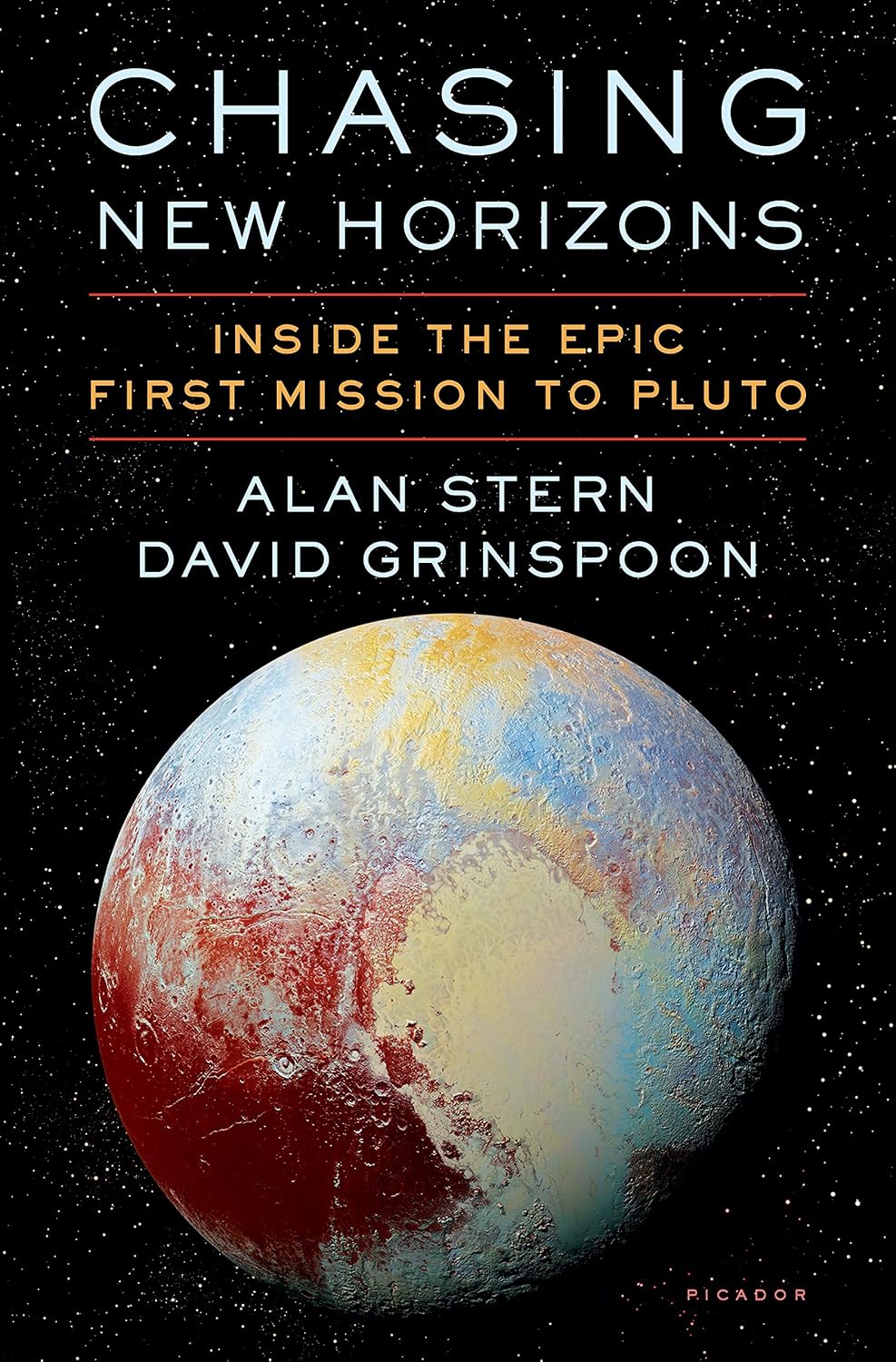
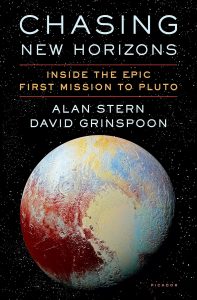
Chasing New Horizons: Inside the Epic First Mission to Pluto
Nonfiction, 2018
On July 14, 2015, something amazing happened. More than 3 billion miles from Earth, a small NASA spacecraft called New Horizons screamed past Pluto at more than 32,000 miles per hour, focusing its instruments on the long mysterious icy worlds of the Pluto system, and then, just as quickly, continued on its journey out into the beyond.
Nothing like this has occurred in a generation—a raw exploration of new worlds unparalleled since NASA’s Voyager missions to Uranus and Neptune—and nothing quite like it is planned to happen ever again. The photos that New Horizons sent back to Earth graced the front pages of newspapers on all 7 continents, and NASA’s website for the mission received more than 2 billion hits in the days surrounding the flyby. At a time when so many think that our most historic achievements are in the past, the most distant planetary exploration ever attempted not only succeeded in 2015 but made history and captured the world’s imagination.
How did this happen? Chasing New Horizons is the story of the men and women behind this amazing mission: of their decades-long commitment and persistence; of the political fights within and outside of NASA; of the sheer human ingenuity it took to design, build, and fly the mission; and of the plans for New Horizons’ next encounter, 1 billion miles past Pluto in 2019.
Told from the insider’s perspective of mission leader Dr. Alan Stern and others on New Horizons, Chasing New Horizons is a riveting story of scientific discovery, and of how much we humans can achieve when people focused on a dream work together toward their incredible goal.
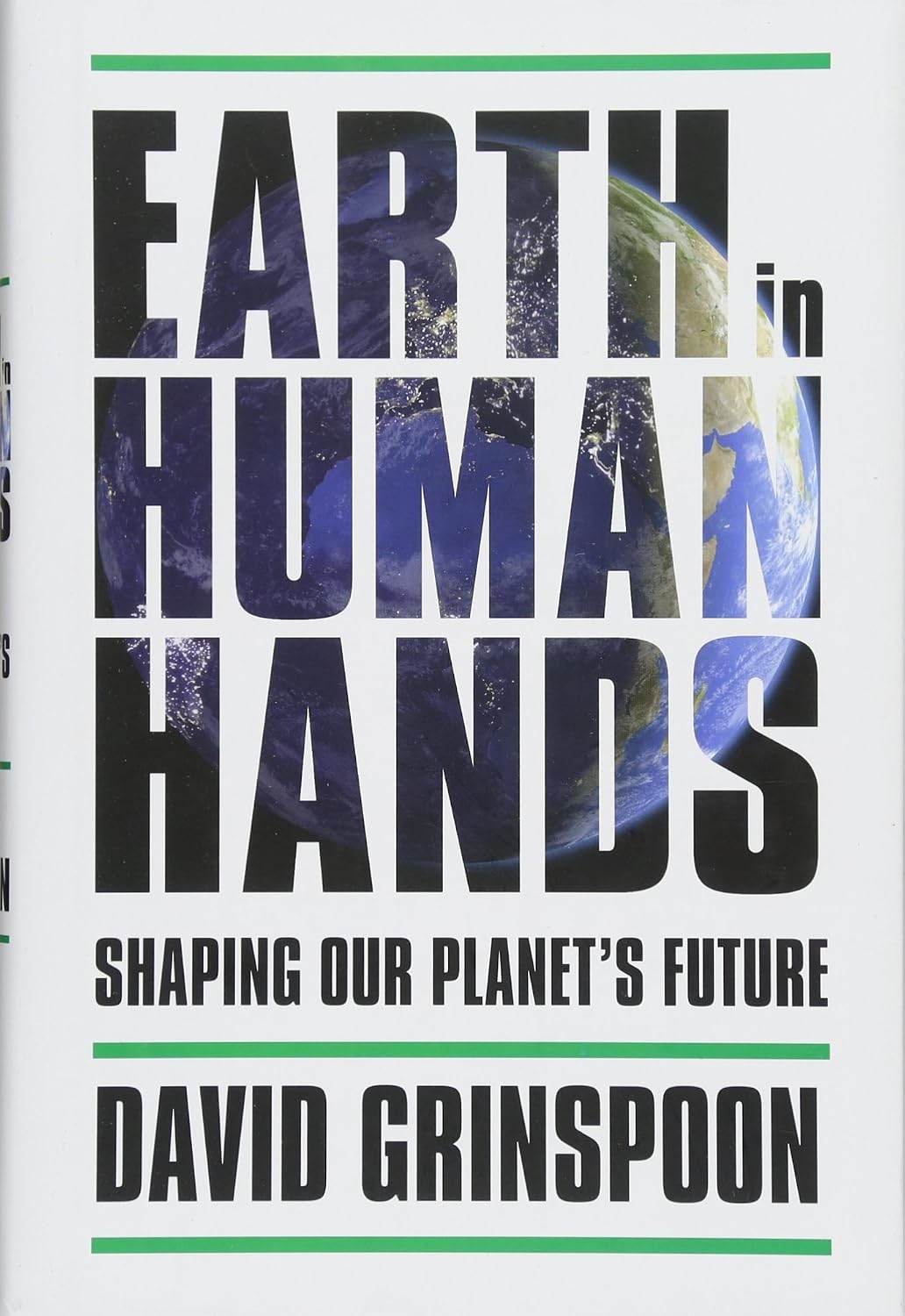
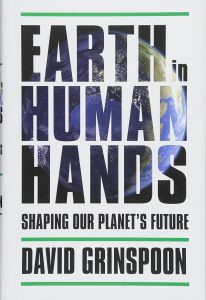
Earth in Human Hands: Shaping Our Planet's Future
Nonfiction, 2016
“In his wonderful writing style, Dr. Grinspoon spells it out: A single species is inducing more profound changes to our planet than any other organism in geologic history. It’s us. If you have family and friends here on Earth, read this book. The Earth is in our hands.”―Bill Nye
For the first time in Earth’s history, our planet is experiencing a confluence of rapidly accelerating changes prompted by one species: humans. Climate change is only the most visible of the modifications we’ve made–up until this point, inadvertently–to the planet. And our current behavior threatens not only our own future but that of countless other creatures. By comparing Earth’s story to those of other planets, astrobiologist David Grinspoon shows what a strange and novel development it is for a species to evolve to build machines, and ultimately, global societies with world-shaping influence.
Without minimizing the challenges of the next century, Grinspoon suggests that our present moment is not only one of peril, but also great potential, especially when viewed from a 10,000-year perspective. Our species has surmounted the threat of extinction before, thanks to our innate ingenuity and ability to adapt, and there’s every reason to believe we can do so again.
Our challenge now is to awaken to our role as a force of planetary change, and to grow into this task. We must become graceful planetary engineers, conscious shapers of our environment and caretakers of Earth’s biosphere. This is a perspective that begs us to ask not just what future do we want to avoid, but what do we seek to build? What kind of world do we want? Are humans the worst thing or the best thing to ever happen to our planet? Today we stand at a pivotal juncture, and the answer will depend on the choices we make.
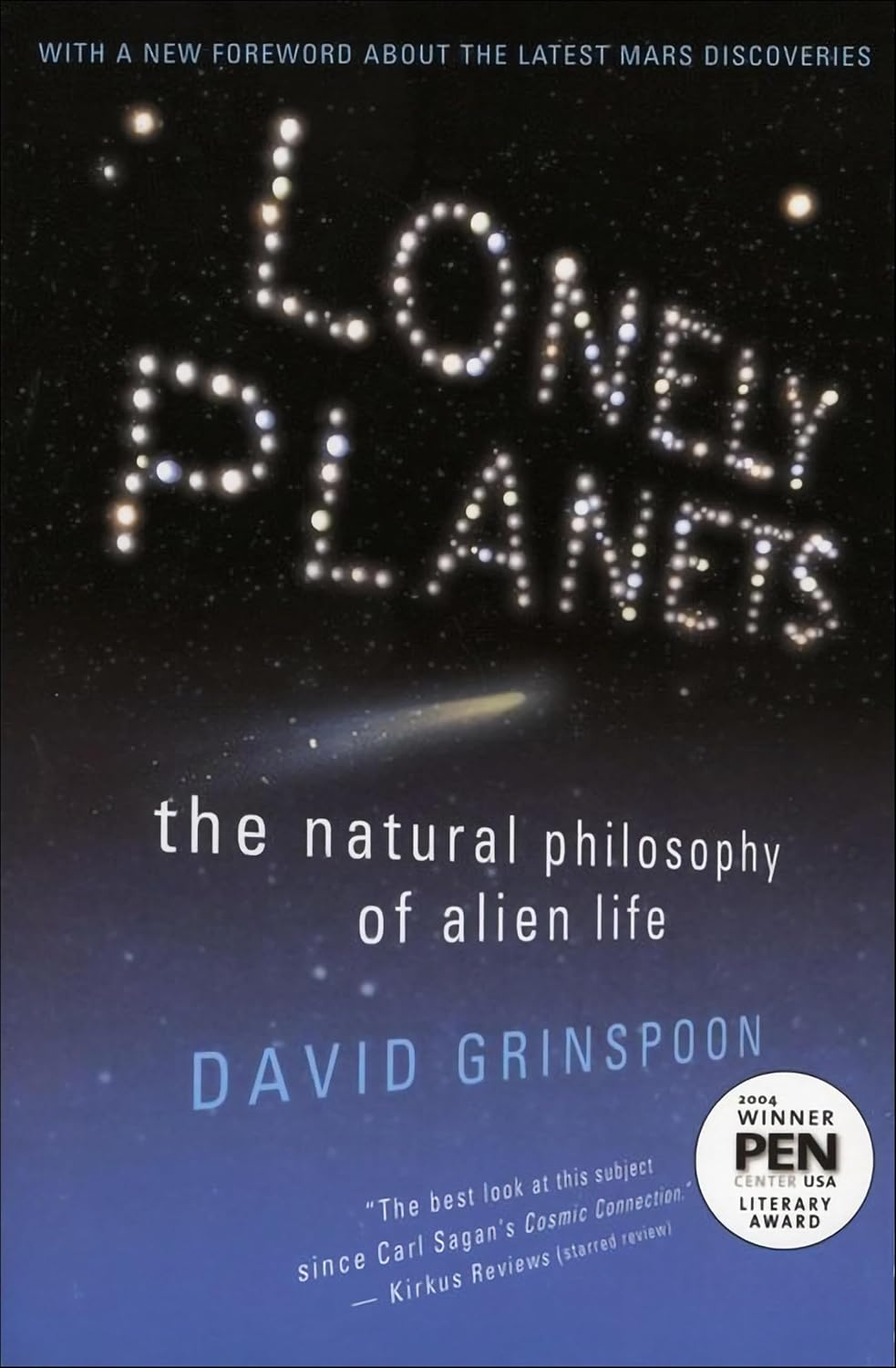
Lonely Planets: The Natural Philosophy of Alien Life
Nonfiction, 2003
It’s been a quarter of a century since Carl Sagan first addressed the general public from the perspective of a practicing scientist confronting the possibility of extraterrestrial life. We’ve learned a lot in those 25 years, and leading astronomer David Grinspoon is well prepared to carry Sagan’s legacy forward to a new generation of readers. In Lonely Planets, Grinspoon explores the big questions with unusual authority, passion and panache: How widespread are life and intelligence in the cosmos? Is life on Earth an accident or in some sense the ‘purpose’ of this universe? And how can we, working from a sample size of one, even begin to think intelligently about life on distant planets? He gives us new ways of thinking about life and outlines his controversial view that Venus, not Mars, is the best candidate for finding nearby life. Lonely Planets concludes with provocative speculations on human destiny and reveals how the search for ET life unites our spiritual and scientific quests for connection with the cosmos.
Examining scientific data, reviewing historical records and sympathetically analyzing folk beliefs, Grinspoon presents a comprehensive history of ideas about extraterrestrial life and offers provocative new scientific speculations. Rich in personal, often amusing anecdotes, his narrative expertly guides readers through history, science, and prevailing beliefs about life on other planets.
Articles & Audio
Read What’s In Print
• Grinspoon Weaves Culture Through Momentous Scientific Events In Earth In Human Hands – WBUR
• Earth in Human Hands: Q&A with Astrobiologist David Grinspoon – Space
• Book Review: Earth in Human Hands – Daily Kos
• Review of Chasing New Horizons – Kirkus Reviews
• Chasing New Horizons: How NASA’s Mission to Pluto Shredded Our Expectations – Paste Magazine
• Review of Lonely Planets – Kirkus Reviews
• The decade of Venus: an interview with David Grinspoon – The Space Review
Listen to Audio
• The Geology of Us: The Anthropocene – with guest Dr. David Grinspoon
• Exploring Venus with David Grinspoon – NASA Gravity Assist Podcast
• Astrobiologist David Grinspoon on life, the universe and everything – Planetary
• Cosmic Queries – Silicon Aliens with David Grinspoon – StarTalk
Selected Writings
EARTH IN HUMAN HANDS (an excerpt)
A Planetary Perspective on the Human Predicament
Gazing over the countless fluctuations and transformations
in Earth’s multibillion‑ year history, I am struck by the unique
strangeness of the present moment. We suddenly find our‑
selves sort of running a planet— a role we never anticipated or
sought— without knowing how it should be done. We’re at the
controls, but we’re not in control. This book is my view of how
we got into this situation, and where that leaves us now.
A child of the space age, I grew up captivated by the romance
of planetary exploration. My timing was right to become a
NASA research scientist working in the new field of astrobiol‑
ogy, the scientific study of life in the universe. My participation
in the spacecraft exploration of other planets has informed my
view of our presence on this one. In these pages I’ll describe
how we humans fit into the long‑ term story of Earth, and how I
believe this knowledge can help us to navigate our current time
of environmental stress and uncertainty about the future.
Although climate change is the most obvious, it is only one
of a large number of interconnected ways in which we have
suddenly begun to modify the planet we inhabit. The scientific
community is now converging on the idea that we have entered
a new phase, or epoch, of Earth history— one in which the net
activity of humans has become a powerful agent of geological
change, equal to the other great forces of nature that build
mountains and shape continents and species. The proposed
name for this new epoch is the “Anthropocene” or the age of
humanity. This concept challenges us to look at ourselves in the
mirror of deep time, measured not just in decades or centuries
or even in millennia, but over hundreds of millions and billions
of years.
The realization that humans may have initiated a new geo‑
logical phase also disrupts and rearranges all our systems of
timekeeping. Think of these three timescales: human history
with its long procession of civilizations, migrations of people,
and waves of technologies, ideas, and modes of thought; geo‑
logic time with its ages and epochs marking fluctuations in envi‑
ronment, climate, and sea level, recorded in the layers of rocks;
and, closely related, biological time, the evolving stages and
forms of life logged in the fossil and molecular records. The
Anthropocene represents a braiding together of these into one
inseparable narrative. This is “the end of history,” and of biol‑
ogy and geology— at least as separate stories. Have they become
irreversibly entwined? It’s conceivable that there may never again
be geological change without human influence.
We are witnessing, and manifesting, something unprec‑
edented and still completely unpredictable: the advent of
self‑ aware geological change. As an astrobiologist, I study the
possible evolutionary relationships between life and the planets
that may host it. I see the Anthropocene as a tricky new step in
the long, intricate dance between Earth and its biosphere that
has been going on for four billion years. There are those who
object to the name Anthropocene as being too self‑ aggrandizing
and serving a destructive, human‑ centered viewpoint. But this
epoch is well‑ named because it represents a recognizable turn‑
ing point in geological history brought about by one species:
anthropos. And our growing acknowledgment of this inflection
can be a turning point in our ability to respond to the changes
we’ve set in motion. I believe that, more than the extreme
and undeniable physical changes to the planet being caused
by human influence, it is this dawning self‑ recognition that is
really fundamentally different and, ultimately, promising about
the Anthropocene. Many species have changed the planet, to
the benefit or detriment of others, but there has never before
been a geological force aware of its own influence.
Popular treatments of this rich subject have too often
focused on the ongoing argument about whether or not the
Anthropocene should officially be recognized as a new epoch
within the geologic timescale, and at what point it began. Yet
that debate has spurred a fascinating re‑examination of the var‑
ious stages of encroaching and accelerating human influence
on Earth since the end of the last ice age twelve thousand years
ago. And the Anthropocene has now garnered the attention of
people thinking far afield of geologic timekeeping. The sharp
human torqueing of Earth’s landscapes, habitats, and global
cycles presents a range of challenges that go well beyond the
physical and biological sciences.
It may seem circuitous to begin a book about the human role
on Earth by talking about the exploration of other planets. I
will try to make the case, however, that looking homeward from
the vantages we’ve gained through our interplanetary journeys
gives us valuable perspective for navigating the planetary‑ scale
changes we are now facing— and causing. We need to learn all
that we can about how planets work, so we can make the transi‑
tion from inadvertently messing with Earth to thoughtfully, art‑
fully, and constructively engaging with its great systems.
The planetary perspective allows us to step away from the
noise of the immediate present, to see ourselves from a dis‑
tance, in time‑ lapse. When we do so, what we see is not just a
problem facing our civilization but an entirely new evolutionary
stage in the development of life. In seeing ourselves as a geolog‑
ical process, we also see the planet entering a phase where cog‑
nitive processes are becoming a major agent of global change.
Earth’s biosphere gave birth to these thought processes, which
are now in turn feeding back and reshaping its changing plan‑
etary cycles. A planet with brains? Fancy that. Not only brains,
but limbs with which to manipulate and build tools. We are just
beginning to come to grips with this strange new development.
Like an infant staring at its hands, we are becoming aware of
our powers but have not yet gained control over them.
It’s a challenging moment for human civilization. The great
restless cleverness of our species has gotten us into a tough spot.
Our collective actions, over which we often seemingly have little
control, threaten the well‑ being of many of our fellow humans,
not to mention vast numbers of our more distant biological rel‑
atives. Our very survival may be threatened. Paradoxically this
comes at a time, and even largely as a result, of unparalleled
advancement in our scientific and technological prowess. But
if we’re so great at figuring things out and inventing solutions
to survival problems, how come we’re in this mess? Part of the
reason we are, so far, stumbling through this transition is that
we have not yet seen it clearly for what it is. I think our funda‑
mental Anthropocene dilemma is that we have achieved global
impact but have no mechanisms for global self‑ control. So, to
the (debatable) extent that we are like some kind of global
organism, we are still a pretty clumsy one, crashing around with
little situational awareness, operating on a scale larger than our
perceptions or motor skills. However, we can also see our civili‑
zation, such as it is, becoming knitted together by trade, by sat‑
ellite, by travel, and instantaneous communications, into some
kind of new global whole— one that is as yet conflicted and inco‑
herent, but which is arguably just beginning to perceive and act
in its own self‑ interest.
We have, unconsciously, been making a new planet. Our
challenge now is to awaken to this role and grow into it, becom‑
ing conscious shapers of our world. We have to “human up” and
accept the responsibility we’ve stumbled into. We didn’t ask for
this. And we may not be up for the challenge, but at this point
we have no choice. However we got here, we find ourselves domi‑
nating many of our world’s systems and needing to learn, under
duress, how to handle that. It’s a complex task, and we have to
learn how to do it without a manual and on the fly. Fortunately,
we may have a leg up. There are some ways in which our evolu‑
tionary history and our unique plasticity as a species may equip
us for the job.
Some of the most amazing things are very easy to take
for granted. How cool is it that I am writing this and you are
reading it? By thwacking away at these dirty little plastic keys in
some coded pattern, I’m sending you a detailed message over
malleable expanses of space and time. What is this magic? Our
fingers were not evolved for this. They were made for grasping
and throwing, touching and feeling, making tools, making din‑
ner, making love. And yet here we are. These human hands and
the nervous systems they are wired to are so flexible, seemingly
made to be rewired as needed. Time and time again our spe‑
cies has escaped existential threats by reinventing ourselves,
outsmarting the toolkit evolution gave us, finding new skills
not coded in our genes to survive new challenges not previously
encountered by our forbearers. We’ve bounced back a few times
from the edge of extinction, and ultimately thrived due to our
abilities to communicate, work collectively, adapt creatively to
changing environments, and solve problems through techno‑
logical and social innovation.
Now we need to do so again. To do the Anthropocene right,
we’ll have to use our innate skills at cooperative problem‑ solving
and innovative tool use to become more effective global actors.
We would so like to avoid this reality, this responsibility, but hav‑
ing seen what we’ve seen, and what we’ve done, we can’t go back
to being ordinary members of the animal kingdom. We also
can’t afford to ignore natural constraints, or imagine we are so
clever we can just invent our way right past them.
I think we’re junior apprentice planetary engineers. We
can’t shrink from this role and to do it well will require finding
a much deeper understanding of both our world and ourselves.
We have, without knowing it, thoroughly reworked our planet.
Now that we are realizing this, what should we do? We cannot
un‑rework it. So we need to rework ourselves into the kind of
creatures who can successfully play the role we’ve unwittingly
assumed.